
Public discussion often treats nuclear material as something that exists only because nuclear power exists. The implication is simple: remove nuclear power, and the problem disappears.
That implication is incorrect.
Long before electricity grids, reactors, or power plants, radioactive elements were already part of the Earth’s crust. Modern industry does not create radioactivity — it concentrates it. And it does so whether nuclear power is used or not.
This article examines an uncomfortable but important reality: even in a world without nuclear power, society would still produce nuclear material — often as waste, often unmanaged, and often unused.
Uranium and thorium are naturally occurring elements. They exist in rocks, soils, and ores across the planet. When humans mine large volumes of material, these elements do not disappear — they are extracted, concentrated, and displaced.
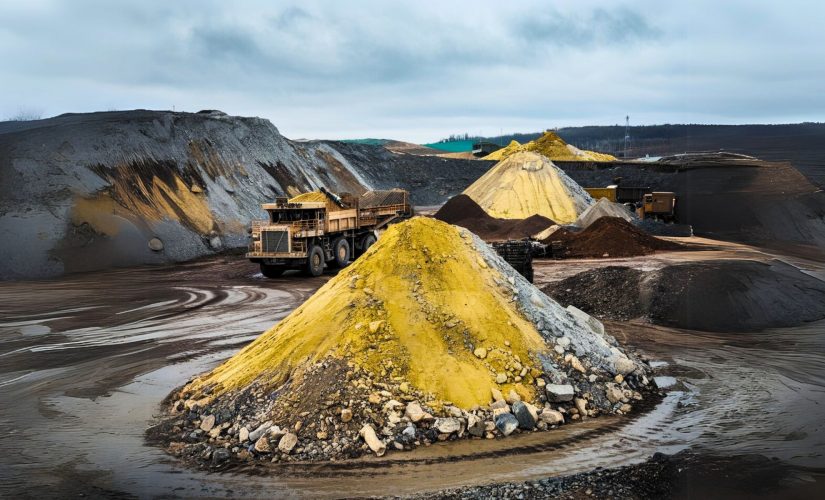
Modern civilization depends on mining at unprecedented scales. As a result, radioactive materials appear routinely as byproducts of industries that have nothing to do with nuclear energy.
Phosphate rock, used primarily for fertilizers, naturally contains uranium.
When phosphate is processed:
uranium often ends up in waste streams
large quantities accumulate in phosphogypsum stacks
the material is typically discarded rather than recovered
Historically, uranium has been extracted from phosphate in several countries. The practice declined not because it was unsafe or impossible, but because uranium prices fell and regulatory complexity increased.
The result: large amounts of potential nuclear fuel are treated as waste.
Rare earth elements are essential for many modern technologies, including:
electric motors
wind turbine generators
electronics
Many rare earth ores also contain thorium, and sometimes uranium.
Because thorium is radioactive:
it is often classified as hazardous waste
it is stored or discarded rather than used
it becomes a long-term environmental liability
Ironically, technologies often described as “green” can generate radioactive waste streams — not because of nuclear power, but because of geology.
Coal contains trace amounts of uranium and thorium.
When coal is burned:
radioactive elements become concentrated in coal ash
the ash must be managed as toxic waste
Globally, coal ash contains more total uranium than all known high-grade uranium mines combined. Yet this material is dispersed, stored, or buried — not used.
Coal power does not eliminate radioactive material. It spreads it.
Nuclear power does not introduce radioactive material into society. It does something very different:
it concentrates radioactive material deliberately
it tracks it precisely
it extracts energy from it under controlled conditions
it isolates the remainder instead of dispersing it
This distinction matters.
Where many industries dilute radioactive material into tailings, ash, or waste piles, nuclear power keeps it contained, monitored, and accountable.
The word waste is misleading.
In a modern nuclear reactor, fuel is removed not because its energy is gone, but because the reactor has reached an engineering limit for that fuel assembly.
After use:
more than 90 percent of the fuel’s potential energy remains
the material is still physically intact
future reactor designs could extract more of that energy
By contrast:
coal, oil, and gas are burned completely
their energy is irreversibly lost
what remains cannot be reused as fuel
In physical terms, nuclear “waste” is often partially used fuel, not exhausted material.
It is important to be careful and precise here.
Mining materials for renewable infrastructure does not automatically produce nuclear fuel. However, in some mining contexts, radioactive byproducts such as thorium are generated and discarded.
In certain cases:
the energy potential of discarded nuclear material is comparable to — or greater than — the lifetime electricity output of the infrastructure it helped build
This does not apply universally. Ore grades, mining methods, and technologies vary. But the underlying point remains:
Radioactive material is already part of industrial supply chains, whether nuclear power is used or not.
The real issue is not whether radioactive material exists. It already does.
The real question is:
How do we handle it responsibly?
Options include:
dispersing it as waste
burying it indefinitely
or using it in controlled systems that extract value while minimizing risk
Nuclear power represents the third option.
Understanding this changes the conversation.
It shifts the debate from:
“Should nuclear exist?”
to:
“Since radioactive materials already exist, how do we manage them wisely?”
That is not an ideological question. It is an engineering, environmental, and ethical one.
Radioactivity is not a political invention. It is a physical property of matter.
Modern industry uncovers it, concentrates it, and moves it around — often without acknowledging it. Nuclear power, for all its challenges, is one of the few systems that treats radioactive material as something to be measured, contained, and respected.
Even in a world without nuclear power, nuclear material would still exist.
The difference is whether we pretend it does not — or take responsibility for it.
Also read Radiation, Risk, and Reality: Separating Nuclear Fact from Fear for a better understanding about radioactivity.
This is an article series "Energy Reality" containing: