
(click here to see the comparison image in full size)
Energy discussions often collapse into large, abstract numbers: megawatts, gigawatts, terawatt-hours. These units are necessary for engineers, but they are difficult to relate to on a human level.
This article takes a different approach.
Instead of looking at countries or power plants, we look at one person. One average life. And we ask a simple question:
How much electricity does a modern human life actually require — and what does that energy look like in physical terms?
To keep this comparison clear and honest, we make a few straightforward assumptions:
Electricity only (not transport fuels or direct heating)
A modern, developed society
Average lifespan: ≈ 80 years
Average electricity use: ≈ 13,000 kWh per year
This gives a clean baseline:
One human lifetime requires roughly 1,000,000 kWh (1 GWh) of electricity.
Everything below represents different physical ways of supplying that same amount of electricity.
A short but important note:
In real systems, energy is always lost during conversion. Power plants are not 100 percent efficient. The quantities shown here therefore represent energy equivalents. Real-world fuel use would generally be higher. This comparison is about scale, not optimization.
Gasoline contains about 9 kWh of energy per liter.
To supply one lifetime of electricity:
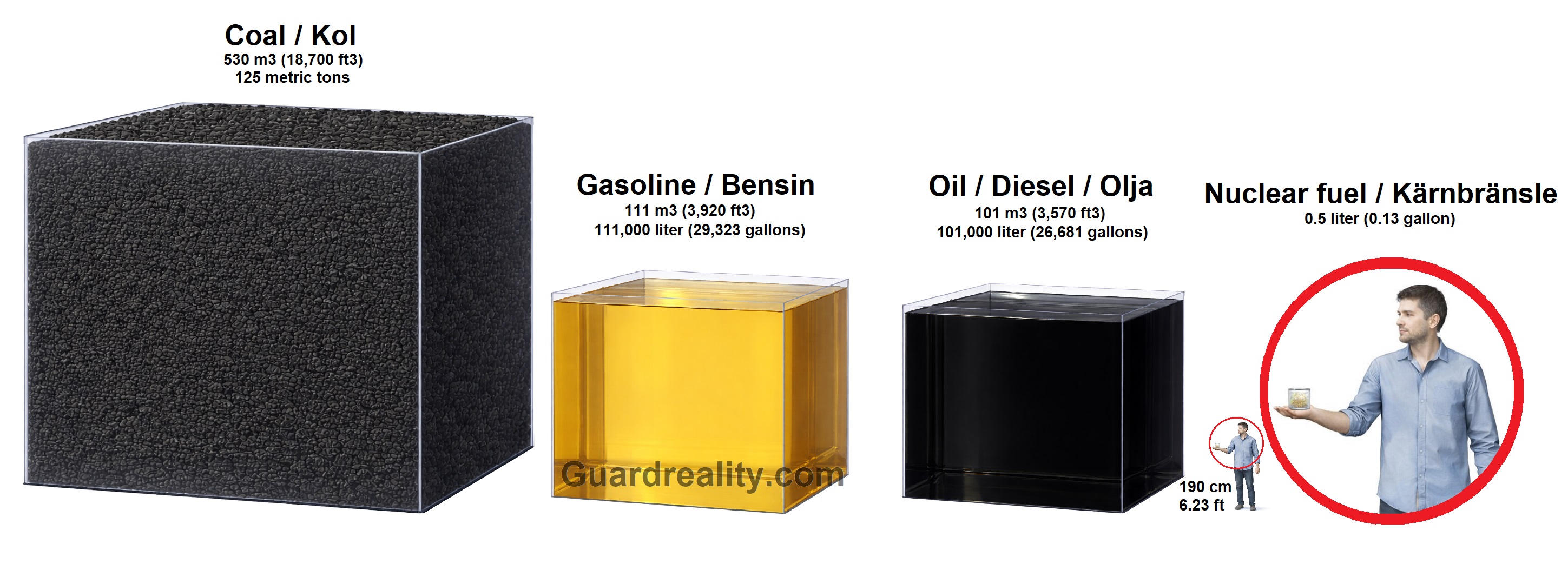
≈ 111,000 liters
≈ 111 cubic meters
That corresponds to dozens of fuel tanker trucks, all consumed simply to power the electricity behind one modern life.
Oil is slightly more energy-dense than gasoline, at roughly 10 kWh per liter.
For one lifetime:
≈ 101,000 liters
≈ 101 cubic meters
A large industrial storage tank, emptied to support the electricity use of a single person over an entire life.
Coal has lower energy density and must be handled in bulk.
For one lifetime of electricity:
≈ 125 metric tons of coal
≈ 530 cubic meters in volume
That is a cube of coal roughly 8 meters on each side, consumed to support one person’s electricity use over a lifetime.
Natural gas is often described as “clean” because it burns with fewer visible pollutants, but it is extremely volume-intensive.
At about 10 kWh per cubic meter:
≈ 101,000 cubic meters of natural gas
This is the gas volume itself, not the volume of compressed tanks. Continuous pipelines, compressors, and uninterrupted flow are required to deliver it.
Hydropower does not consume water, but it does require large amounts of water to pass through turbines.
Assuming a generous 100-meter height difference and high efficiency:
≈ 4,000,000 cubic meters of water
That is equivalent to roughly 1,600 Olympic-sized swimming pools flowing through turbines over the course of one lifetime.
Hydropower works because nature continuously moves water. The energy comes from flow, not storage.
Here the scale difference becomes difficult to grasp intuitively.
To supply one lifetime of electricity in a modern nuclear reactor requires:
On the order of about half a liter of nuclear fuel
≈ 0.5 liter (0.13 gallon)
That amount fits easily in the palm of a hand.
The fuel does not burn. It does not release energy through chemistry. It releases energy through changes in the atomic nucleus itself, which is why the difference in scale compared to other fuels is so extreme.
The word waste carries very different meanings depending on the energy source.
When coal, oil, gasoline, or natural gas are used to produce electricity, they are burned completely. Their energy is released as heat, and what remains is ash, exhaust gases, and residues that cannot be reused as fuel. The energy is gone forever.
Nuclear fuel is different.
After years of operation in a modern reactor, more than 90 percent of the fuel’s potential energy still remains in the material. The fuel is removed not because the energy has been used up, but because the buildup of certain byproducts makes continued use in that reactor less practical.
In other words, while fossil fuels are consumed until nothing usable remains, nuclear fuel is set aside while most of its energy is still intact.
This distinction is one of the strongest arguments for continued research in nuclear technology.
Advanced reactor designs and fuel recycling methods aim to extract more of the energy already present in existing fuel. Doing so would:
increase total energy obtained from the same material
reduce the volume of long-lived waste
improve overall safety and efficiency
From a physical perspective, much of today’s nuclear “waste” is not an exhausted resource, but a partially used one. Physics allows more energy to be recovered if the technology is developed responsibly.
Placed side by side, these comparisons reveal a simple truth:
Fossil fuels require vast volumes and mass
Hydropower relies on continuous natural movement
Nuclear energy delivers enormous energy from minimal material, and even then uses only a fraction of what is available
None of these facts are opinions. They follow directly from physics.
A modern human life is supported by an extraordinary amount of energy. That alone deserves respect.
When energy debates become emotional, it is often because scale is invisible. By translating electricity into physical quantities, scale becomes tangible: trucks instead of kilowatt-hours, tanks instead of charts, pools instead of percentages.
This article does not argue for a policy.
It offers a lens.
And sometimes, seeing clearly is the most important step of all.
This is an article series "Energy Reality" containing: