

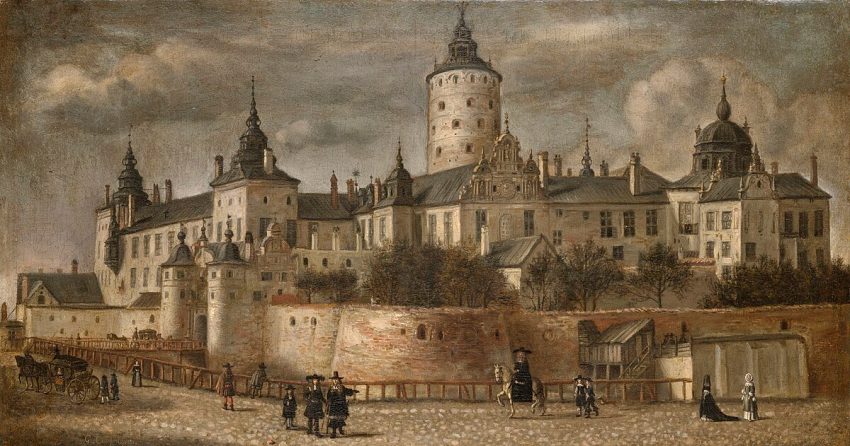
For several centuries, Tre Kronor Castle had grown into both a royal residence and the administrative heart of the Swedish state. It was not the product of a single architectural vision, but the result of gradual expansion from the Middle Ages onward. Stone and timber coexisted throughout the structure, often with older wooden elements concealed behind later masonry.
By the late seventeenth century, the castle housed not only the royal household but also large parts of the kingdom’s archives, libraries, and administrative offices. Its importance was therefore both symbolic and practical.
On 7 May 1697, a fire broke out that would destroy most of the castle.
The fire began in the attic, above the great state rooms. From there it spread rapidly through the upper parts of the building, where large quantities of dry timber and old beams created ideal conditions for fire. Its elevated position made early access difficult.
Efforts were made to extinguish the flames, but these were hampered by the size, height, and internal complexity of the structure. The fire moved through hidden cavities and along construction elements invisible from within. Once it gained momentum, it exceeded the capacity of the available firefighting methods.
Attention soon shifted from extinguishing the fire to salvaging movable property. Documents, furnishings, and valuable objects were carried out or thrown from windows in an attempt to limit the losses. Despite these efforts, vast portions of the kingdom’s written heritage were destroyed.
When the fire finally subsided, only fragments of the walls remained. Tre Kronor Castle was, in practical terms, lost.
At the time of the fire, a formal fire-watch system was in place at the castle. Its purpose was to monitor sources of heat, smoke, and potential hazards, relying on constant presence and rapid response.
Subsequent investigations revealed that this system had not functioned as intended. Fire-watch duties had been neglected, and personnel assigned to fire safety had at times been diverted to private tasks unrelated to their official responsibilities. As a result, preparedness was reduced at a critical moment.
This was regarded as a serious failure of duty, regardless of whether the origin of the fire itself could be traced to a specific act.
A comprehensive legal inquiry followed the disaster. The focus was not on establishing the precise cause of the fire—something that could not be determined with certainty—but on the exercise of responsibility before and during the event.
The sentences imposed were severe. Death sentences were issued, though several were later commuted to corporal punishment and forced labor. The harshness of these penalties reflected the magnitude of the loss rather than individual culpability as understood in modern terms. When the administrative center of the state had been destroyed, decisive accountability was required to restore order and authority.
The fire of Tre Kronor fire cannot be explained by a single cause. It resulted from a vulnerable building, inadequate fire protection, organizational shortcomings, and a blaze that developed at a particularly critical moment. It was a systemic failure rather than an isolated accident.
In the aftermath, plans were made to construct a new royal palace on the same site. The new building was designed in stone, with greater attention to fire safety, separation of spaces, and structural clarity. The loss of Tre Kronor thus became a turning point in how permanent state buildings were conceived.
The fire marked the end of a medieval architectural complex and the beginning of a new architectural and administrative era.