

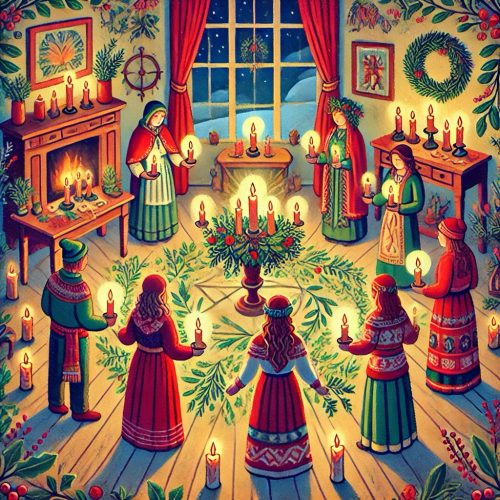
Long before a tree stood in the corner of a living room, decorated with candles and glass, evergreen branches were carried indoors for a simpler reason: they stayed alive when everything else died.
In northern climates, winter was not symbolic. It was physical, immediate, and dangerous. Fields lay bare. Trees stood skeletal. Food stores thinned. Life withdrew.
Evergreens were different.
Fir, spruce, and pine kept their needles through the cold months. They did not bloom, but they endured. For people living close to the land, that endurance mattered. Long before Christianity reached northern Europe, branches of evergreen were brought into homes during midwinter. Not as decoration, but as reassurance.
They were reminders that life had not disappeared—only paused.
These practices were not unified rituals. They varied by region and custom. Some hung branches over doors. Others laid them on tables or hearths. The meaning was practical before it was spiritual: green meant survival.
When Christianity spread across Europe, it did not erase existing winter customs. It absorbed them.
Midwinter festivals already existed. The winter solstice already mattered. Bringing green indoors already felt natural. Rather than fight these habits, the church allowed them to remain, gradually reframing their meaning.
Evergreen branches began to symbolize not just survival, but eternal life. Continuity replaced endurance. The old habit stayed; the explanation changed.
For centuries, this was the extent of it. There was no “Christmas tree” yet—only greenery, used sparingly and temporarily.
The first recognizable Christmas trees appear in German-speaking regions during the late Middle Ages and early modern period. At first, they were not universal household items. They appeared in guild halls, churches, and wealthy homes.
These trees were not decorated lavishly. Apples, nuts, wafers, and candles were common. Everything placed on the tree was edible or reusable. Nothing was wasted.
Candles mattered most. In a dark season, light was precious. A tree carrying light was not subtle symbolism—it was direct.
Even then, the practice spread slowly. Many communities viewed indoor trees as unnecessary or excessive. Others found them impractical. A tree indoors took up space, required care, and posed fire risks.
It was a choice, not a rule.
The Christmas tree became widespread much later than most people assume.
Its expansion across Europe accelerated in the 18th and 19th centuries, carried by cultural exchange rather than theology. German traditions moved with migration and marriage. One royal household, in particular, mattered more than doctrine ever did.
When Queen Victoria and Prince Albert were depicted with a decorated Christmas tree in the 1840s, the image spread rapidly. What the royal family did, people copied. Not because it was ancient or sacred—but because it looked warm, orderly, and intimate.
The tree became a domestic symbol.
From that point on, its meaning shifted again. It was no longer about survival or eternity. It was about family, pause, and home.
As the tree spread, its symbolism became less explicit. People no longer needed to explain why the tree mattered. It simply did.
Ornaments replaced food. Glass replaced fruit. Electric lights replaced candles. The risks decreased, but so did the need for meaning.
By the early 20th century, the Christmas tree was expected. It no longer marked belief or identity. It marked the season.
That expectation is important. Traditions become powerful not because they are understood, but because they are repeated.
The Christmas tree survived because it solves several human needs at once:
It brings nature indoors during the least natural season
It creates a focal point without demanding explanation
It invites participation—decorating is collective, not solitary
It is temporary, and therefore special
Unlike permanent symbols, the tree appears, serves its purpose, and disappears again. That rhythm matters. It mirrors the season itself.
Strip away the ornaments, the theology, the commercial weight, and the tree still carries its oldest meaning.
In the darkest part of the year, people bring something living into their homes.
Not because it explains the world—but because it quietly contradicts despair.
That was true before Christmas.
It remained true after.
And that is why the tree stayed.