
It began the way many things in seventeenth-century London did: quietly, indoors, and without witnesses who thought it mattered.
Sometime after midnight on September 2, 1666, a fire started in a bakery on Pudding Lane. Ovens were kept burning through the night; embers were a routine hazard. The city slept through it at first. When the flames were noticed, they did not yet look remarkable—just another domestic fire in a city that saw them often.
London had lived with fire for centuries. Chimneys cracked, sparks escaped, roofs smoldered. Most fires burned out. A few took a house or two. This one, at first glance, appeared no different.
But the night air was dry, and a steady wind was blowing from the east.
As the fire climbed from the bakery into the upper floors, it reached the roof and found something it liked. The flames stretched sideways, brushing the eaves of the neighboring building. Wood darkened, then caught. The gap between the houses was narrow enough that heat alone was sufficient. No leap was needed. The fire simply extended itself.
People began to wake. Buckets were fetched. A hand pump was dragged into place. Water was passed from the Thames in the slow rhythm Londoners knew well. These early responses were practiced, almost routine. Fires were fought this way, and usually won.
By dawn, that confidence was already eroding.
The wind strengthened as the sun rose. Burning fragments lifted into the air and came down ahead of the main blaze, tapping softly against rooftops before igniting them. New fires appeared not in a line, but in patches—here, then suddenly there. The streets were too narrow to create clear gaps. The fire did not advance so much as multiply.
Officials debated what to do. One option existed that everyone understood but few wanted to invoke: pulling down houses to create firebreaks. This meant destroying private property, possibly unnecessarily, in the hope of stopping a fire that might still burn itself out. The decision required authority, and authority hesitated.
While the discussion continued, the fire grew.
By midday, entire blocks were burning. The heat was no longer confined to individual buildings; it filled the streets. Air rushed inward at ground level, feeding the flames, then rose violently upward. The fire had begun to move the air around it. Water thrown onto the edges hissed and vanished.
At some point—no one could say exactly when—the city lost the ability to influence events.
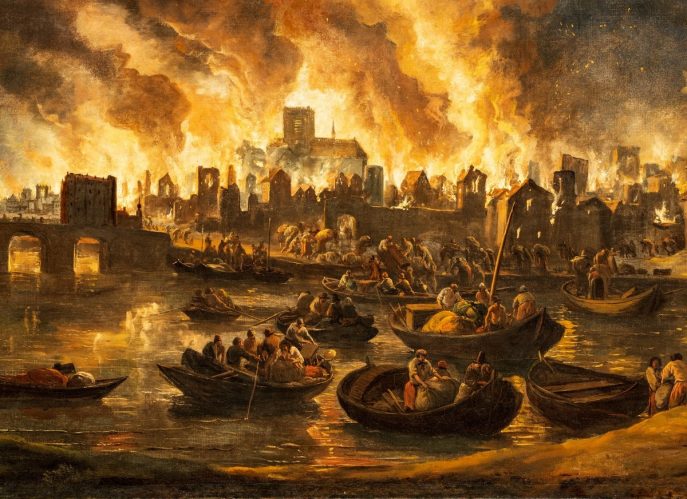
Samuel Pepys, watching from the river, recorded the sight with growing unease. From a distance, the fire looked almost orderly: long lines of flame, smoke rising in columns, the glow spreading westward. Closer in, it was chaos—people dragging trunks, carts overloaded with furniture, animals driven through crowds that barely parted. The Thames filled with boats carrying whatever could be saved. Some fled; others stayed, convinced their parish or church would be spared.
Stone buildings fell. Churches burned from the inside as their wooden roofs collapsed. Bells melted and rang once as they dropped. The sound carried across the city.
Still, the fire did not race. It advanced steadily, relentlessly, over days rather than hours. This slowness saved lives. People could see it coming. They could move, if only just ahead of it. The disaster unfolded in full view, giving time for escape even as it destroyed almost everything people owned.
By the fourth day, the wind eased. Firebreaks—finally wide enough—began to hold. The flames starved, then shrank, then went out. What remained was a city transformed into ash and blackened stone.
Roughly four-fifths of the old City of London was gone.
Only after the embers cooled did the questions fully form. How could a single bakery fire do this? Why had no one stopped it? Why did familiar methods fail so completely?
The answers were not dramatic. No hidden enemy. No secret plot. Just a city shaped by countless ordinary decisions.
London had been built upward and inward to save space, each generation adding floors to houses already standing. Timber was cheap, abundant, and easy to work. Streets narrowed as buildings crept outward. Workshops stored fuel. Rooflines aligned just close enough for heat to cross them. Firefighting relied on human chains and small pumps, effective only while fires stayed small.
Each choice made sense on its own. Together, they created a city with enormous fuel packed into tight spaces, and almost no margin for error.
The Great Fire of London—known formally as the Great Fire of London—was not the result of ignorance about fire. People in 1666 understood fire intimately. They lived with it every day. What they did not yet understand was how quickly danger changes when scale changes.
A fire that consumes one building behaves very differently from a fire that consumes a hundred. Heat grows faster than the ability to remove it. Air itself becomes part of the mechanism. Methods that worked yesterday fail silently once a threshold is crossed.
London rebuilt, and in doing so quietly acknowledged the lesson. Streets widened. Brick replaced timber. Fire insurance companies formed and maintained their own brigades. None of this required new discoveries—only the recognition that the city itself had been part of the problem.
The fire was not an accident waiting to happen in a single night. It was the final consequence of long familiarity mistaken for safety.