
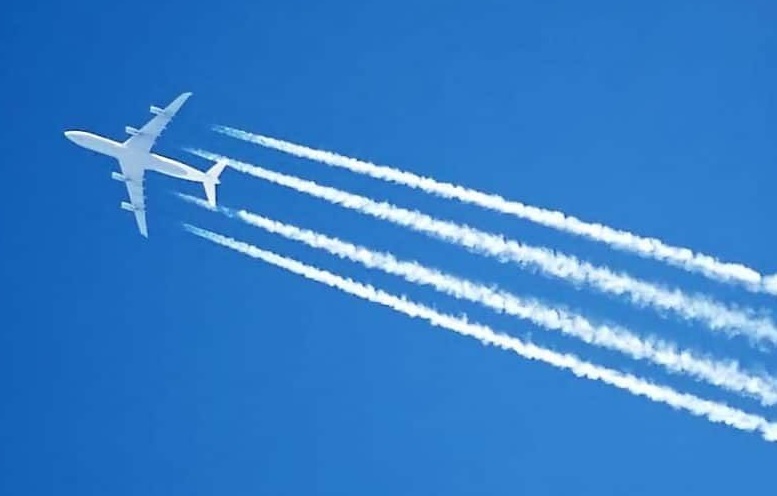
Look up on a clear day and you may see long white lines stretching across the sky behind passing airplanes. Sometimes they vanish quickly. Other times they spread out and linger for hours.
This has led some people to believe airplanes are releasing chemicals — often referred to as “chemtrails.”
In reality, these trails are a well-understood physical phenomenon, explained by basic chemistry and atmospheric conditions.
No secret spraying is required.
The white trails behind aircraft are called condensation trails, or contrails.
They form when:
jet engines burn fuel, producing exhaust gases
that exhaust contains water vapor
the plane is flying at high altitude where the air is extremely cold
At cruising altitude (often 8–12 km):
temperatures can be −40 °C to −60 °C
air pressure is very low
When hot, moist exhaust mixes with this cold air, the water vapor condenses and freezes almost instantly into tiny ice crystals.
Those ice crystals reflect sunlight — which is why the trail looks white.
If the surrounding air is:
relatively dry
the ice crystals:
evaporate rapidly
and the trail fades within seconds or minutes
This is why many contrails appear short and fleeting.
If the surrounding air is:
cold and humid
the ice crystals:
do not evaporate
can spread out slowly
and may form thin, cloud-like layers
In these conditions, contrails can:
widen
drift with high-altitude winds
merge with other contrails
This variation is often misinterpreted as “different substances,” when it’s actually different atmospheric conditions.
A key observation that argues against spraying claims:
The same aircraft, using the same fuel and engines, can produce very different trails on different days — or none at all.
If planes were intentionally releasing chemicals:
trails would appear consistently
behavior would not depend on humidity or temperature
But contrails behave exactly as physics predicts for water vapor and ice.
People sometimes ask why contrails seem more common today than decades ago.
Several reasons:
air traffic has increased dramatically
modern jet engines are more efficient and produce cooler exhaust
flight routes are denser and higher
More planes + better conditions for condensation = more visible trails.
No new substance is required.
Conspiracy explanations often spread because they:
offer simple answers to complex systems
give a sense of hidden knowledge
turn uncertainty into certainty
Seeing patterns in the sky without understanding atmospheric physics can feel unsettling. The human brain naturally looks for intentional causes, even when processes are automatic.
That doesn’t make people foolish — it makes them human.
For a global spraying program to exist, it would require:
millions of pilots and engineers staying silent
modified aircraft visible to maintenance crews
chemicals surviving extreme heat in jet engines
delivery systems working unnoticed across every major airline
Meanwhile, the water-vapor explanation requires nothing beyond known physics and matches observations perfectly.
When the simplest explanation fits all the evidence, it’s usually the correct one.
Contrails can:
slightly influence cloud formation
have small, temporary climate effects
They do not:
contain toxic chemicals
affect human health directly
represent deliberate spraying programs
These impacts are openly studied and discussed — not hidden.
The white trails behind airplanes are not chemicals being released into the atmosphere. They are ice crystals formed from water vapor in jet exhaust, shaped by temperature and humidity at high altitude.
Understanding this doesn’t require trust in institutions — just:
basic thermodynamics
observation
and consistency with physical laws
When we replace speculation with explanation, the sky becomes less mysterious — and much more interesting.
Also check out: When Airplanes Do Release Substances.