
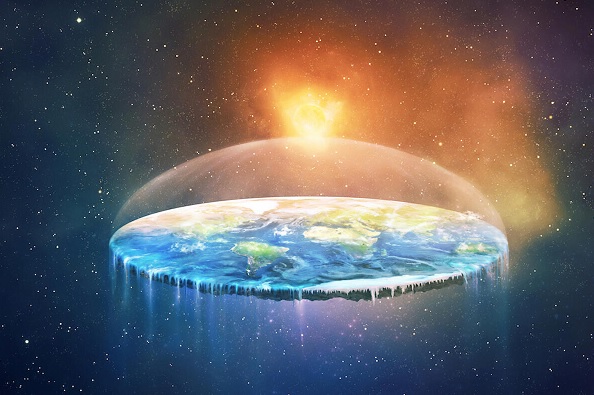
Belief in a flat Earth is puzzling to many. The evidence for a spherical Earth is extensive, accessible, and centuries old. Satellites orbit the planet, navigation systems rely on orbital mechanics, and everyday technologies quietly confirm the same geometry.
Yet flat Earth beliefs persist. Understanding why requires less focus on astronomy—and more on human psychology.
It is tempting to assume that people who believe the Earth is flat simply “don’t understand science.” That explanation is comforting—but wrong.
Flat Earth belief appears across education levels. What differs is not raw intelligence, but how trust, identity, and certainty are handled.
People are not persuaded by facts alone. They are persuaded by stories that feel coherent, emotionally satisfying, and socially reinforcing.
A common thread among flat Earth believers is deep institutional distrust.
Instead of asking:
“What evidence best explains reality?”
The question becomes:
“Who is lying to me—and why?”
Once that frame is adopted:
Scientific institutions are assumed to be deceptive
Governments are presumed to coordinate misinformation
Independent confirmation is reinterpreted as collusion
At that point, any evidence from outside the belief system is treated as suspect by default.
Flat Earth communities often display a pattern known as motivated reasoning—the tendency to evaluate information based on whether it supports a desired conclusion.
This leads to several recurring strategies:
Evidence is never “enough.” Each explanation leads to new demands, often more extreme than the last.
Mainstream science is questioned relentlessly, while claims from within the group are accepted with little scrutiny.
When predictions fail, the failure itself is treated as proof of suppression or sabotage.
In this framework, being contradicted feels less like being wrong—and more like being persecuted.
Beliefs rarely exist in isolation. Over time, flat Earth belief can become part of a person’s identity.
It offers:
A sense of being “awake” while others are “deceived”
Belonging to a tight-knit community
A clear narrative of heroes and villains
Once belief becomes identity, changing one’s mind feels like losing social ground, not gaining knowledge.
Facts that threaten identity are resisted far more strongly than facts that merely challenge opinions.
Observers often notice that explanations used to defend flat Earth claims seem increasingly strained or convoluted.
This is not accidental.
When a belief must be defended against overwhelming evidence, explanations tend to:
grow more complex
rely on ad-hoc assumptions
contradict each other over time
The goal shifts from explaining reality to preserving the belief.
This is not unique to flat Earth thinking—it appears in many strongly held belief systems, scientific or otherwise.
Flat Earth belief is an extreme example of a more general phenomenon:
People are better at defending beliefs than revising them.
The same cognitive patterns appear in:
political polarization
health misinformation
conspiracy thinking more broadly
Flat Earth belief persists not because the evidence is weak—but because beliefs serve psychological and social needs that evidence alone cannot replace.
Ridicule rarely works. Nor does overwhelming someone with facts.
More constructive approaches include:
asking calm, open-ended questions
focusing on how we know things, not just what we know
emphasizing shared values like curiosity and honesty
allowing people space to change their minds without humiliation
Changing deeply held beliefs is usually a slow, personal process—not a debate victory.
Belief in a flat Earth is not a failure of science. It is a reminder that humans are not purely rational processors of evidence.
Facts matter—but trust, identity, and belonging often matter more.
Understanding this does not require agreement with the belief.
It requires recognizing how easily any of us can become attached to explanations that feel meaningful—even when they are wrong.
That insight may be more important than the shape of the Earth itself.